The Stress in Action (SiA) team at the University of Twente (UT) and Erasmus MC reached an important milestone. The SiA UT team formally handed over their VR-based stress induction instrument to Erasmus MC.
Stress-Happi at Erasmus MC
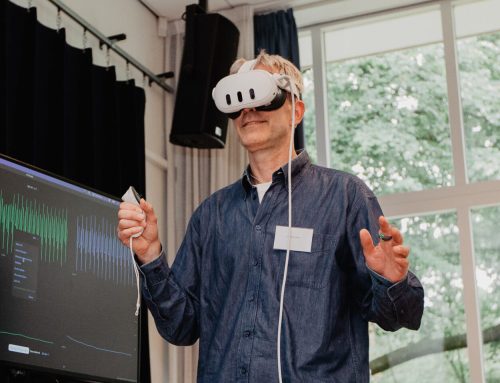
Stress in Action colleagues at Erasmus MC (Robin Lengton and Joëlle Oosterman) will deploy the VR-based stress induction instrument within the clinical research study Stress-Happi. In this study multiple measurements are combined, including cortisol sampling, wearable sensors, experience sampling, and controlled lab assessments. These will be captured both in daily life and during stress-inducing tasks. The aim is to deepen our understanding of how different stress responses relate to one another and to identify which measurement methods are most reliable for assessing stress in real-world conditions.
VR-based stress induction instrument
The VR-based stress induction instrument is developed by the BMS Lab at UT (Jan-Willem van ‘t Klooster and Jordi Weldink) and the Psychology Health Technology (PHT) section at UT (Magdalena Sikora and Matthijs Noordzij). This instrument provides a fully described, controlled yet highly realistic environment for eliciting stress responses. By simulating scenarios such as high-altitude exposure, cognitive challenges, and interview settings, the protocol enables precise evaluation of stressors and supports the validation of stress-monitoring technologies, including wearable devices.
Interested in the instrument? Read more about it here: https://osf.io/3xn5z (Sikora et al., 2024).