One of the SiA Career support Core’s (CASC) main goals is to provide education in all areas of the SiA programme, thereby boosting the international standing of daily-life stress researchers.
In February we hosted our second 3-day training programme for SiA’s PhD students. This edition, we welcomed DESTRESS early career researcher in the programme too! The week started with very icy conditions in the Northern provinces of the Netherlands. Therefore we had to decide to offer an online course on Wednesday 4th of February. Later that day, all participants managed to arrive in the city of Groningen to gather during the social programme at night and the following days of the Interdisciplinary Education Week at University of Groningen on the 5th and 6th of February.
This training programme included expert lectures and collaborative sessions focused on stress in the workplace, daily-life stress and its impact on mental and cardiometabolic health, data analyses and methodologies. Participants explored various career opportunities in and outside of academia. The programme also provided time for social interaction, fostering connections among junior researchers, connecting both consortia.

Stress in the workplace
On Wednesday we were properly introduced to the topic of stress in the workplace and the DESTRESS programme. Prof. Dr. Christiaan Vinkers provided a lecture on the concept of burn out. In the afternoon Prof. Dr. Frederieke Schaafsma talked about stress in the workplace from an occupatoinal phyisician’s point of view. Additionally, Mark Siertsema elaborated on the DESTRESS programme and highlighted all work packages, objectives and research goals.
It was an interesting day bringing Stress in Action and DESTRESS closer together, both in understanding of concepts and in collaboration amongst early career researchers.
Cardiometabolics & Analysis
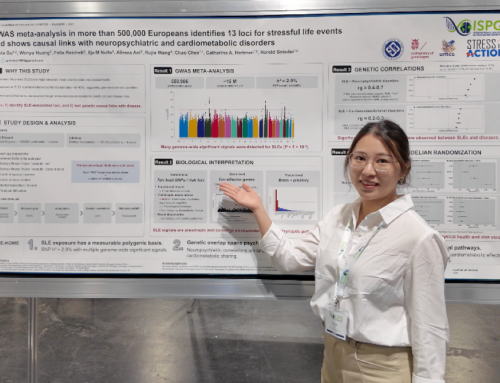
On Thursday we touched upon two important, and very different, themes in stress research: cardiometabolic health and longitudinal data analysis. Prof. Dr. Harold Snieder started the day with a lecture on stress and genetics and their impact on blood pressure and heart rate variability. He was followed by Susanne Kuckuck who told us all about the relation between stress and obesity.
In the afternoon we learned more about longitudinal data analysis from Prof. Dr. Dimitri Rizopoulos and other members of DASC. After a step-by-step workflow we separated in groups to discuss questions about machine learning, statistics and methodologies the consortium members currently encounter in their research.
Career Perspectives
On the last day of the course we focused on career journeys. We invited four speakers from different fields to discuss their career journeys after obtaining their PhD. The speakers presented themselves and their trajectories, followed by a Q&A session led by one of the PhD students. We were happy to welcome dr. Frank Blaauw, CEO at Researchable; dr. Bertus Jeronimus, associate professor at University of Groningen; dr. Femke Abma, senior researcher at RIVM; and dr. Heleen van der Meer, senior programme manager ZonMw.
The course was successfully completed by 35 PhD students in the Stress in Action and DESTRESS consortia. Thank you for participating, your devotion and enthusiasm!
Thanks to the Junior Think Tank for organising eventful social activities on Wednesday and Thursday night. We enjoyed a lovely pizza party and Jeu de Boules activity in Groningen city centre. Bringing together junior researchers from all over the country for three days, is the best way to build bridges, collaborations and building an even stronger consortium. Add some icy conditions, and you have a very successful ‘winterschool’!