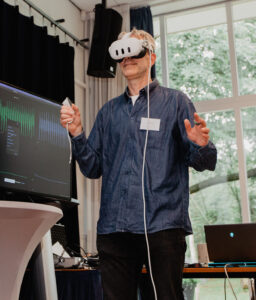
How can researchers determine whether a wearable device reliably measures the body’s response to stressors? To find out, a person needs to be subjected to a stressor that feels realistic but which is also easy to repeat in a controlled manner. Virtual Reality (VR) allows to create such experiences, but it is unclear which are most effective at triggering stress responses.
In this review, Magdalena Sikora and colleagues used 110 studies and compared 11 distinct stressor tasks across three main stressor categories: social judgement, environmental or physical danger, and cognitive challenges. They examined how these VR tasks were designed, which stress responses researchers measured, and how strong these responses were.
The most effective VR stressor was the established public speaking and mental arithmetic task – the Trier Social Stress Test. The second most promising task category utilized extreme virtual heights. Some studies used wearables to record physiology, showing that combining wearables with VR is feasible. No studies have however used VR to test wearables on their accuracy for capturing stress responses.
The findings suggest that VR is a promising tool to create effective stressors which could help researchers test wearable devices. The review also provides guidance on VR stressor selection and design.
Virtual reality offers a practical way to create controlled, repeatable stressful situations for research and potentially for testing wearable devices. However, stress responses may be weaker than in real-life versions of the same task. Researchers should hence balance VR’s practical advantages with the type and strength of the stress response needed.