Are you going to Lowlands this summer? You can participate in science! Stress in Action’s Stress Roulette is one of the experiments in the science line up of Lowlands Science this year (21-23 August, Biddinghuizen, Netherlands).
At the Stress Roulette experiment at Lowlands Science 2026, festivalgoers can take to the stage themselves! This stage isn’t about singing, dance moves, or artistic flair; festivalgoers are invited to give a short talk! Researchers from ‘Stress in Action’ are curious to see how stressful this experience is. Will participants sweat, stutter, and wish it was over as quickly as possible? Or will there be participants who feel completely at home on stage?
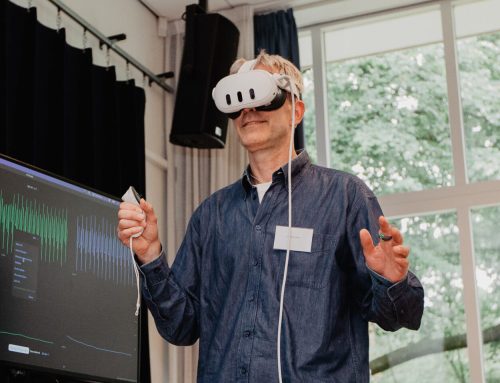
This experiment demonstrates the process of stress over time. The researchers measure stress before the talk (anticipation), during the talk (reactivity), and afterwards (recovery). They investigate how stress develops over time and study the body’s physiological response throughout this process. This is done using the VU-AMS Core, a wearable device that streams participants’ heart rate and breathing, allowing the audience to watch live what is happening inside the body. In addition, personal characteristics and stress levels are assessed with a short questionnaire, and stress over a longer period is analysed using hair cortisol.

Dr Martin Gevonden (VU Amsterdam, Biological Psychology) is the lead researcher for this experiment at Lowlands Science. Martin leads the development team of VU-AMS, this VU invention—a kind of Fitbit squared—is considered the gold standard for measuring the autonomic nervous system and is used by universities worldwide, even as far as Patagonia. Martin is enthusiastic: “Now it’s Biddinghuizen’s turn! Last year at Lowlands Science, I did some trial measurements on myself. Festival life is mostly great fun, but there are also lots of stimuli and all sorts of things happening in your body. It’s fantastic to now be able to visualise the stress and relaxation of fellow Lowlanders live at Lowlands Science.”

PhD candidate Ellen Stroemer (UMCG Health Sciences) is particularly interested in the course of individual stress responses over time. She studies the dynamics of the stressor experienced by an individual and their response to it, including anticipation, reactivity, and recovery. Ellen explains: “With this research, we aim to better understand why some people start the experiment with an already elevated stress level, while others mainly react strongly during the stressful task or take longer to recover afterwards. We look, for example, at differences in accumulated stress over the past period and at how people typically deal with emotions.”

PhD candidate Kiera Drake (University of Groningen, Organisational Psychology) conducts research into stress interventions in daily life and is particularly interested in participants’ recovery after the experiment. Kiera explains: “What fascinates me is why some people are open to interventions, while others reject them. With this research, we want to better understand what happens in the moment between experiencing stressors and the subsequent stress responses, and how this relates to the choice to use or not use an intervention. I am really looking forward to carrying out this research at Lowlands Science and am proud to contribute to such a unique combination of science and festival culture.”

Stress in Action at Lowlands
Stress affects all aspects of daily life. Prolonged and high levels of stress increase the risk of mental disorders (such as depression, anxiety, and burnout) and physical illnesses (such as cardiovascular disease, diabetes, and obesity). These stress-related diseases place a significant burden on global health. Yet there is still much to discover about how stress arises and develops in everyday life. That is why we study stressors and stress responses outside the laboratory, in a real-world setting. Lowlands is ideal for this: the festival provides a natural, stressful environment with many stimuli, social interactions, little sleep, and large crowds. This allows us to study stress responses and patterns as they occur in real life and to develop interventions that are well suited to everyday life.
This research is carried out by researchers from Stress in Action. https://stress-in-action.nl/
Stress in Action is a collaboration of VU Amsterdam, University of Groningen, UMCG, Amsterdam UMC, Erasmus MC, Utrecht University and University of Twente.