
Many smartwatches nowadays provide stress scores: scores that indicate how stressed you are throughout the day. However, these scores are far from perfect and many people are confused by them. In this paper, Merel van den Berg and colleagues, discuss the key issues of stress scores. For instance, the stress scores only reflect the state of our body, and not necessarily our mental state, disregarding an important part of our experience of stress. Moreover, the measurements and calculations behind the stress scores are not transparent, making it even more difficult to understand the scores. Furthermore, data overviews and visualisations of the stress scores often imply that high stress scores are always bad, which is not the case (think about emergency situations or high-adrenaline leisure activities).
The researchers propose different directions to overcome these current issues, such as using better terminology (like “bodily stress reactions”) and increasing the transparency behind the stress score calculations. This paper also provides recommendations for more neutral data feedback, such as subtly changing the temperature of the watch to indicate stress levels. The researchers believe that the potential of stress scores can only be achieved when we strive for accurate, responsible, and human-centered design of this technology.
By highlighting key issues with current stress scores, the researchers call on technology companies, designers, and researchers to address these challenges, improve the technology, and prevent unintended consequences (e.g., causing unnecessary anxiety over stress levels).

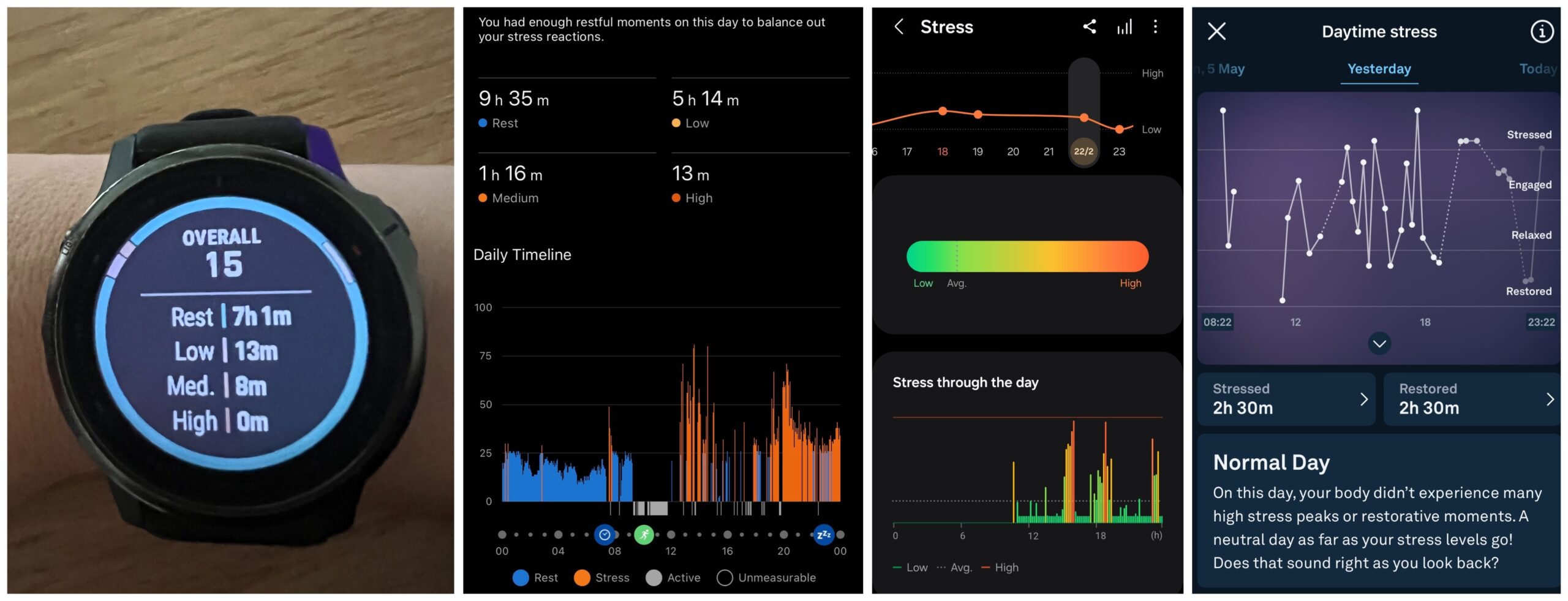
The image shows stress scores provided by three different wearables: Garmin Fenix smartwatch (1+2), Samsung Galaxy Watch (3), and Oura ring (4)


